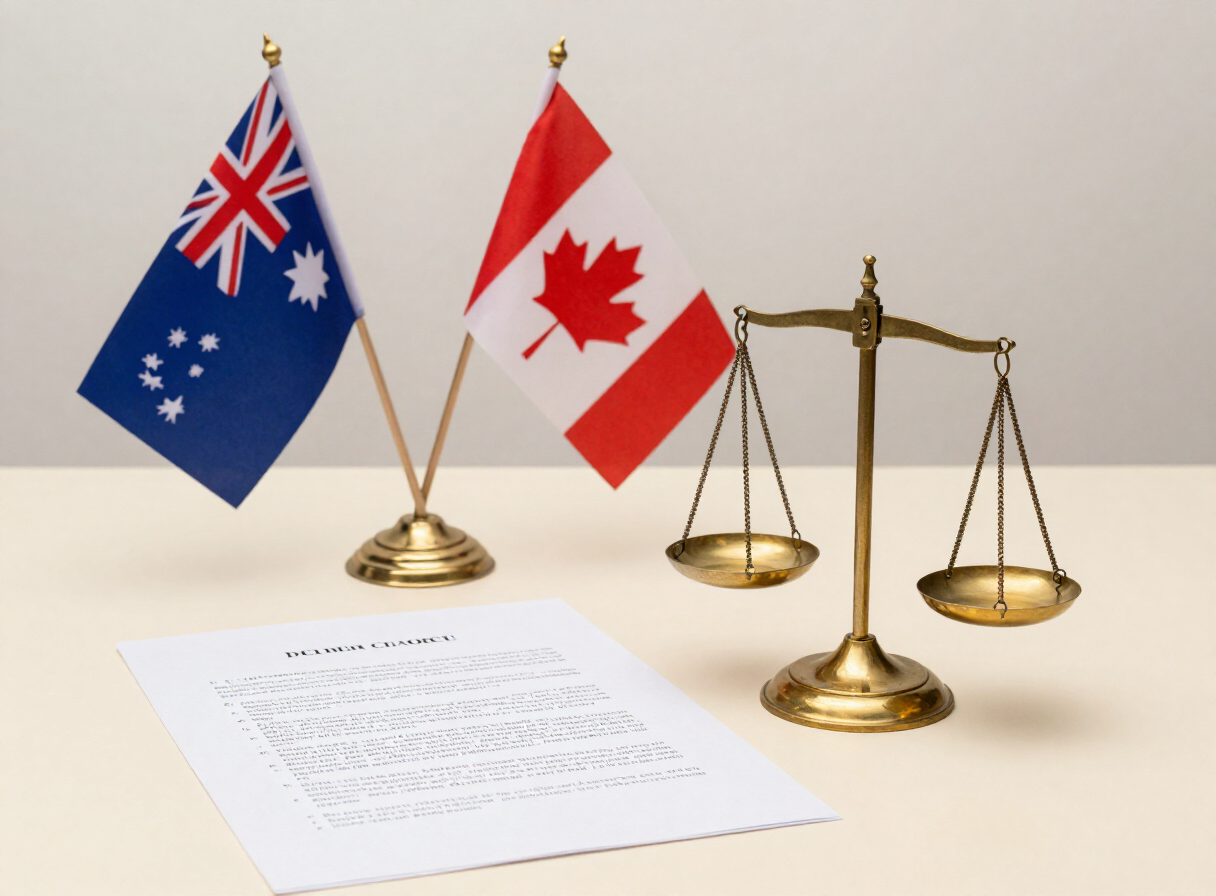
Australia and Canada host substantial and growing Indian-origin populations, and divorces obtained there raise their own distinct recognition questions in India. This guide walks through both systems and how Indian courts treat decrees from each.
Australia: The Family Law Act 1975
Divorce in Australia is governed by the Family Law Act, 1975, a unified federal statute (unlike the US, family law in Australia is not state-based). Australia applies a single no-fault ground — that the marriage has irretrievably broken down, evidenced by twelve months of separation — and the Family Court of Australia or the Federal Circuit and Family Court exercises jurisdiction where either party is an Australian citizen, is domiciled in Australia, or has been ordinarily resident there for at least twelve months before filing.
Canada: Provincial and Federal Divorce Jurisdiction
Divorce in Canada is governed by the federal Divorce Act, applied through the provincial superior courts, giving it more procedural uniformity across provinces than the US system while still requiring the parties to file in the province where at least one spouse has been ordinarily resident for a minimum of one year. The sole ground for divorce is breakdown of the marriage, most commonly evidenced by one year of separation, though adultery and cruelty remain available grounds.
Recognition and Enforcement in India
Neither Australia nor Canada has been notified by the Government of India as a "reciprocating territory" under Section 44A of the Code of Civil Procedure, 1908. Decrees from both countries therefore follow the same fresh-suit route applicable to the United States: a party must file a civil suit in India under Section 13 CPC seeking recognition and a domestic decree, rather than directly executing the foreign decree. The foreign decree is strong evidence before the Indian court, but is not self-executing.
For Australian decrees specifically, the twelve-month separation requirement and the Family Court's detailed property and parenting orders are usually accepted at face value by Indian courts absent a genuine natural-justice or jurisdictional challenge; Canadian decrees are treated similarly, with Indian courts giving weight to the provincial court's detailed findings on residency and separation.
Case Law on Recognition
Ashok Kumar v. Ashok Kumar (High Court, 2012) — citation not independently verified
This High Court ruling addressed the recognition of a foreign matrimonial decree where the respondent spouse alleged inadequate notice of the foreign proceedings, holding that the burden lies on the party relying on the foreign decree to affirmatively establish that the opposing spouse had genuine notice and opportunity to contest — a principle applied consistently across Commonwealth-origin decrees including those from Australia and Canada.
Priya Sharma v. Vikram Sharma (Delhi High Court, 2018) — citation not independently verified
The Delhi High Court examined a matrimonial dispute involving cross-border elements, reiterating that Indian courts will decline to treat a foreign decree as conclusive where it is shown to rest on a jurisdictional basis (such as brief or contested residency) that Indian private international law would not itself recognise as sufficient — underscoring why NRI couples should document their residency and separation carefully wherever the divorce is filed. Book a confidential consultation with Advocate Shailender Singh in Lucknow.
Need legal help in Lucknow?
Speak with Advocate Shailender Singh.
Confidential, experienced representation before the Allahabad High Court (Lucknow Bench), Family Court and UP-RERA. Discuss your matter today.