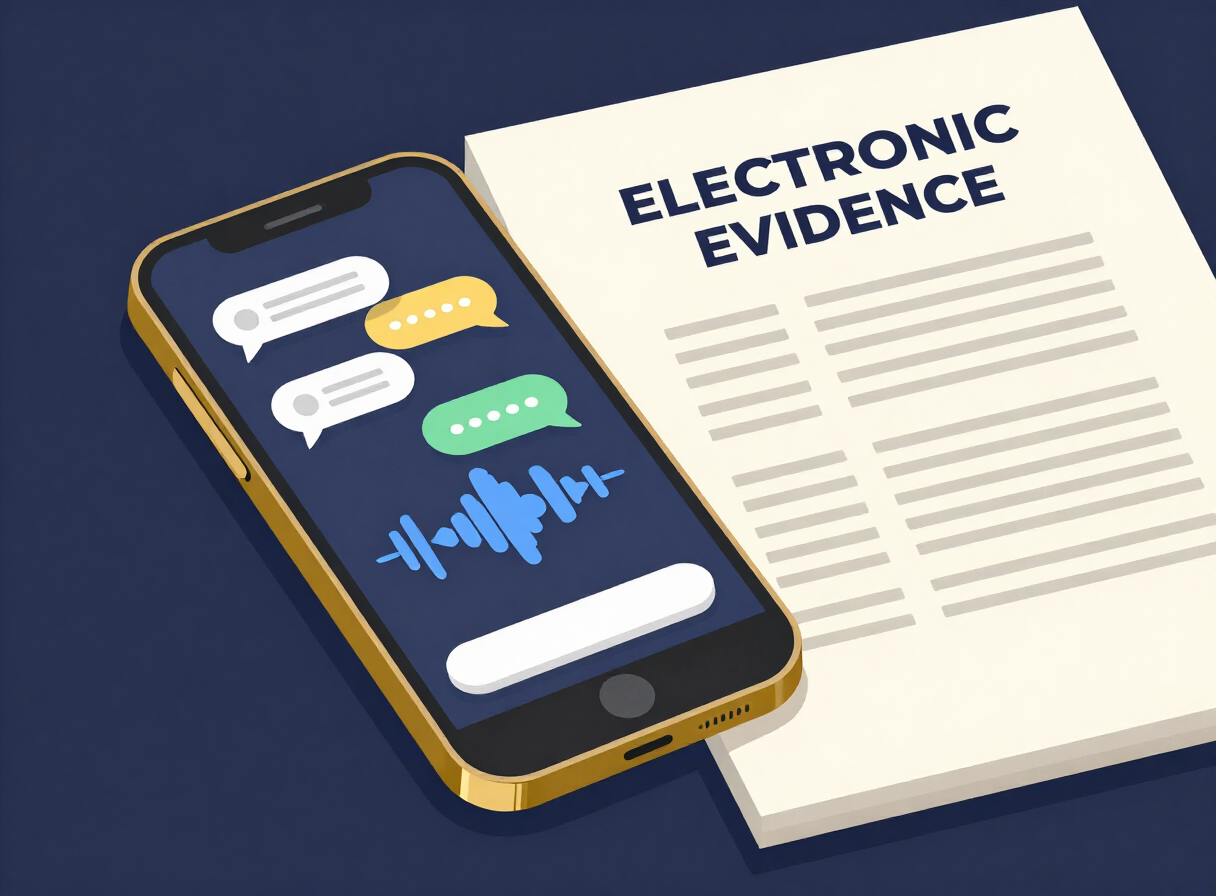
Contested divorce cases are rarely proved by eyewitnesses. Chats, call recordings, photographs and bank messages carry much of the proof of cruelty or desertion, so two questions decide whether they count: is the material admissible, and has it been properly authenticated?
Secretly recorded calls between spouses are admissible
Hon'ble Apex Court in case of Vibhor Garg v. Neha, 2025 INSC 829 : [2025] 7 SCR 611 (14 July 2025, B.V. Nagarathna and Satish Chandra Sharma, JJ.) set aside a Punjab and Haryana High Court order that had barred a husband from using recordings of his wife's calls in his divorce petition, and restored the Family Court's order allowing them. The Court held that Section 122 of the Indian Evidence Act, 1872, which protects marital communications, itself excepts "suits between married persons", so no consent was needed.
Hon'ble Apex Court in Vibhor Garg (para 9.5) has stated that "The three-fold test of relevance, identification and accuracy has to be satisfied before a Court admits a recorded conversation in evidence." On privacy, the Court observed (para 10.3) that "snooping between partners is an effect and not a cause of marital disharmony", and held that the exception in Section 122 must be read with the right to a fair trial. The Court approved Deepti Kapur v. Kunal Julka, 2020 SCC OnLine Del 672, among other High Court decisions.
Section 14 of the Family Courts Act
Section 14 lets a Family Court receive any report, statement, document, information or matter that may assist it to deal effectually with a dispute, whether or not it would be relevant or admissible under the Evidence Act. In Vibhor Garg the Court found that resort to Section 14 was not required on those facts, because "the Evidence Act itself permits such a communication to be admitted in evidence by way of an exception" (para 10.2). Section 14 is therefore a backstop, not a licence to rely on unverified screenshots.
Authentication: from Section 65B to Section 63 BSA
Hon'ble Apex Court in case of Anvar P.V. v. P.K. Basheer, (2014) 10 SCC 473 held that secondary electronic evidence is not admissible unless the requirements of Section 65B of the Evidence Act are met. Hon'ble Apex Court in case of Arjun Panditrao Khotkar v. Kailash Kushanrao Gorantyal, (2020) 7 SCC 1 (14 July 2020, three Judges) held that the certificate under Section 65B(4) is a "condition precedent to the admissibility of evidence by way of electronic record".
The Bharatiya Sakshya Adhiniyam, 2023 replaced Section 65B with Section 63. Section 63(4) requires a certificate in the form in the Schedule. Hon'ble Apex Court in case of Pune Bar Association v. Union of India (decided May 2026) upheld that requirement and recorded that "Part A … requires disclosure of hash value of the electronic records in addition to the declaration required under the erstwhile Section 65B of the Evidence Act. Part B of the certificate requires a further declaration signed by an expert." The Court held that Part B may be signed by a person with special skills in computer science and cyber forensics, not only by an examiner notified under Section 79A of the Information Technology Act, 2000.
Practical checklist
- Keep the original device or memory card and do not edit or forward-and-delete the file.
- Record the hash value in Part A and obtain the Part B expert certificate before filing.
- Identify the speakers and the date of each recording, and offer the original for inspection.
- Expect cross-examination on context and completeness; the Court in Vibhor Garg stressed relevance, identification and accuracy.
Frequently asked questions
Is a call recorded without my spouse's knowledge admissible in a divorce case?
Yes, subject to relevance, identification, accuracy and proof, per Vibhor Garg.
Is a printout of WhatsApp chats enough?
No. A certificate under Section 63(4) BSA is required for electronic records tendered as evidence.
Who signs Part B?
An expert; the Supreme Court has held that a person with special skills in computer science and cyber forensics can sign.
Does Section 14 of the Family Courts Act remove the need for a certificate?
Do not assume so; the safer course is to file the certificate.
General legal information, not legal advice
Related reading:
Related services:
This article gives general information on the law and is not legal advice. It is not an advertisement or solicitation of work; the Bar Council of India does not permit advertisement or solicitation by advocates. Reading it does not create an advocate-client relationship. The law is stated as on 5 November 2026 and may change; please check the current position before relying on it.
Need legal help in Lucknow?
Speak with Advocate Shailender Singh.
Confidential, experienced representation before the Allahabad High Court (Lucknow Bench), Family Court and UP-RERA. Discuss your matter today.